


Thermography: applications and advantages
Thermography is a technique for detecting and visualizing infrared radiation emitted by objects and bodies based on their temperature. This technology uses thermal infrared, a form of electromagnetic radiation that is invisible to the human eye but can be captured by specialized thermographic devices.
The underlying principle of thermography is that all objects with a temperature above absolute zero (-273.15°C) emit infrared radiation. The amount and distribution of this radiation depends on the object’s temperature. Thermographic devices, such as thermal cameras, can detect this radiation and translate it into thermal images, where different colors or hues represent different temperature levels.
Thermography is a versatile and powerful technology that offers numerous advantages in terms of early detection of problems, non-invasiveness, and safety. Thermometric cameras measure without contact and without feedback, at a distance and in motion, with extremely short response times. For this reason, they are widely used in a variety of sectors.
In what sectors are thermographic cameras used?
Heat measurement is a fundamental analysis in many fields, as temperature is a crucial variable that significantly affects environments and materials. Thermographic analysis can be applied to many areas:
- Automotive – to control the temperature of materials under stress conditions
- Chemical industry – to measure the heat resulting from exothermic reactions
- Metallurgical industry – to optimize the production process or to monitor machinery
- Agriculture – to measure soil temperature and crop health, evaluate irrigation efficiency or greenhouse thermal efficiency, but also to control temperature in animal farms
- Construction sector – to evaluate heat loss in buildings and improve energy efficiency
In the industrial sector in particular, heat measurement via thermography is widely used in the diagnostics and inspection of industrial plants: thermographic analysis allows us to identify malfunctions and anomalies in industrial equipment, such as motors, transformers, and electrical cables, or defects and structural problems in materials.
Advantages of thermography
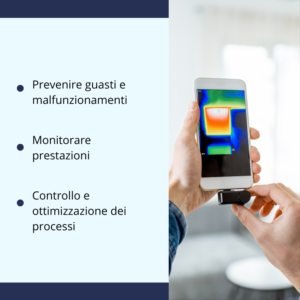
The most obvious advantage is the broad spectrum of situations and applications in which thermography can be used for a variety of purposes. Heat is a quantity that strongly affects materials, potentially causing them to weaken; for this reason, temperature measurement is a useful practice in various sectors for the purposes of:
However, there are two other fundamental advantages that make thermographic analysis particularly valid as a temperature measurement method.
Non-destructive testing
Non-destructive testing is one of the specific characteristics of thermography, allowing information to be obtained without directly touching the object or area of interest being examined, and therefore without causing any damage or physical alteration. This is particularly useful in situations such as building inspections, medical diagnostics, or the inspection of sensitive equipment. The ability to obtain detailed information remotely makes thermography an extremely safe and inexpensive temperature measurement method.
Simplicity and ease of use
The simplicity and speed of use of thermal imaging cameras allow for rapid acquisition of valuable information on the thermal distribution of objects and surfaces, allowing them to be used by professionals in various sectors without the need for specialized skills. Modern thermographic cameras are designed with intuitive and easy-to-understand user interfaces, with the ability to record and save images and data, making it easier to compile and share reports. The compactness and lightweight nature of infrared heat meters also allow them to be transported and used in a wide variety of locations.
Contact us for more information on thermographic cameras.